[Editorial] The Unvarnished Truth of the Korean Economy
[Editorial] The Unvarnished Truth of the Korean Economy: Can a Second Renaissance Dawn Without Structural Reform?
The 2025 economic scorecard for South Korea has been unveiled. A cursory glance at the macroeconomic indicators released by the Bank of Korea and Statistics Korea might suggest that the economy is still experiencing a gradual expansion.
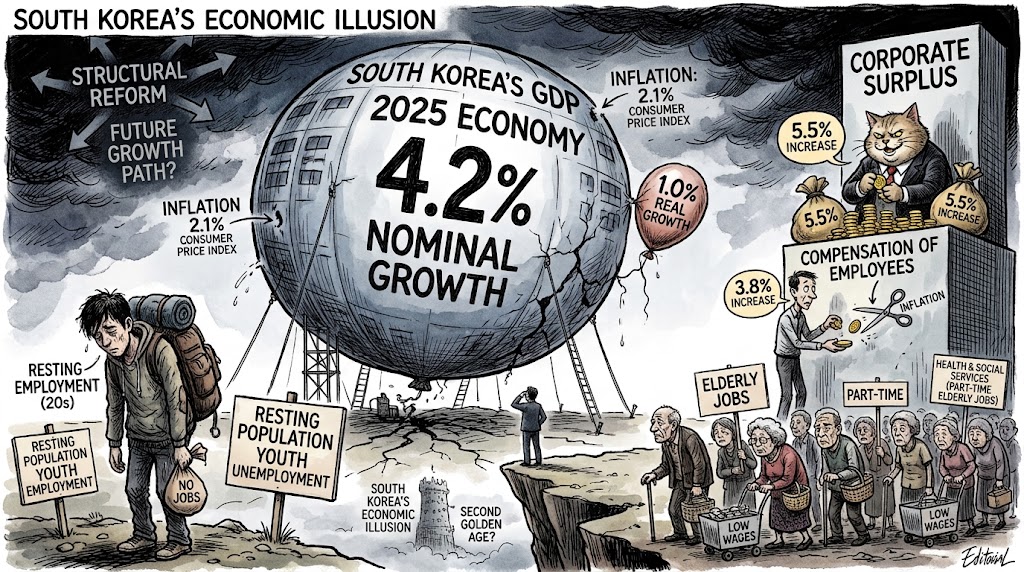
In 2025, nominal Gross Domestic Product (GDP) grew by approximately 4.2% year-on-year, and Gross National Income (GNI) per capita maintained the $36,000 level. The compensation of employees—the share of income flowing to households—increased by 3.8%, and the number of employed persons grew by 193,000 over the year.
However, stripping away the superficial optical illusions created by these numbers reveals a precarious reality and structural limitations that strike at the very bone of our economy.
The most concerning aspect is the "quality of growth"—a phenomenon of bulking up without building muscle.
While nominal GDP grew in the 4% range, the annual real GDP growth rate for 2025, which strips out inflation to reveal the true physical stamina of the national economy, stood at a mere 1.0%.
This indicates that our economy did not physically expand by creating new value; rather, its nominal size merely swelled on the back of inflation. A real growth rate of 1.0% is a stark warning letter signaling that the dynamism of our economy is turning stone-cold.
Looking at the "distribution scorecard" among economic agents makes the situation even more bitter. Analyzing the income approach to GDP—which shows how the generated value-added was divided—net taxes on production and imports (the government's share) grew by only 1.9%, and the compensation of employees (the households' share) increased by 3.8%.
In stark contrast, the gross operating surplus (the enterprises' share) jumped by 5.5%. Even in a 1% low-growth environment, the share of capital distributed to the corporate sector remained robust, while the pie of income returning to workers failed to keep pace, exposing a clear skew in distribution.
A deeper problem is that the 3.8% increase in the household share is largely a mirage. According to Statistics Korea, the annual consumer price inflation rate for 2025 was 2.1%.
Even if the total nominal labor cost increased by 3.8%, once taxes and inflation are deducted, the real wage increase felt by workers is essentially stagnant or even regressing.
Even more fatal are the underlying employment metrics propping up this 3.8% figure. The total number of employed persons increased by 193,000 in 2025. Yet, employment among those in their 20s and 30s—the backbone and future of the labor market—actually shrank.
The vast majority of newly created jobs were absorbed by the elderly population aged 60 and above. Broken down by industry, quality jobs in manufacturing and construction plummeted, while part-time, low-wage positions surged, predominantly in the health and social welfare service sectors heavily subsidized by government funding.
Ultimately, the 3.8% growth in aggregate labor income is not the result of our economy creating high value-added to boost wages, nor is it the result of generating abundant, high-quality jobs for the youth.
It is merely an optical illusion caused by an overall increase in headcount, as part-time, subsistence-level jobs for the elderly filled the void left by declining high-wage opportunities.
Our growth engine has stalled in the 1% range, and the warmth of distribution is only lingering around the weakest links of the labor market. Young people, unable to find quality jobs, are abandoning economic activity to join the "resting" population, while households, crushed by inflation, are snapping their wallets shut.
Amidst this double jeopardy of cooling growth momentum and a deteriorating distribution structure, we are forced to ask a solemn question:
Can the South Korean economy truly overcome these profound structural adversities and usher in a second golden age?
Enjoyed this article?
Subscribe to CEO Daily Brief and get core insights into the South Korean market delivered to your inbox every morning.
Comments 0
No comments yet. Be the first to share your thoughts!