[Op-Ed] Why the South Korean Government Has No Choice But to Rely on Samsung and SK for Semiconductor Investments
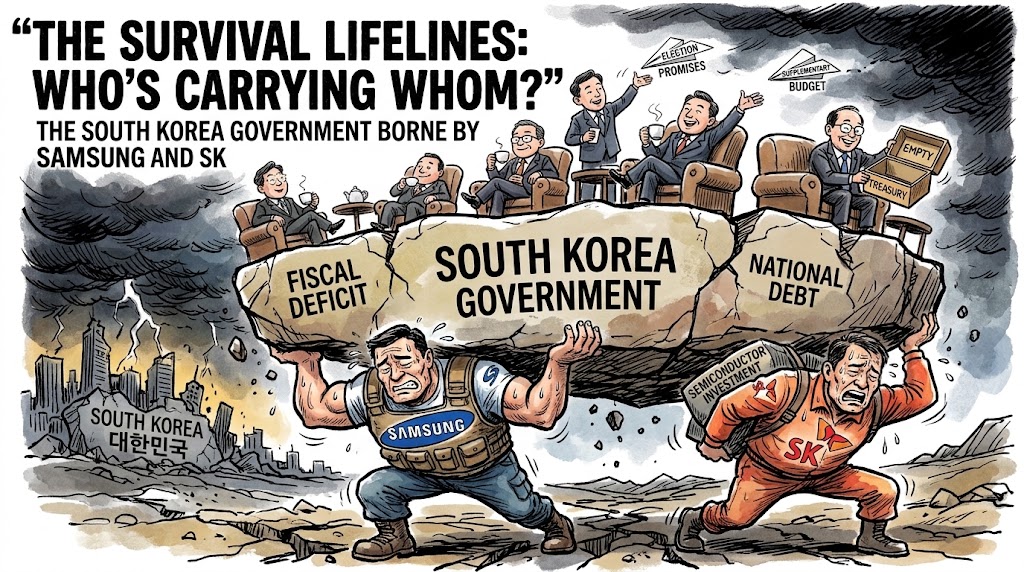
Whenever the South Korean government unveils its annual budget, the public is easily dazzled by the sheer astronomical scale of the figures. For 2025, total expenditure was set at a staggering $498.7 billion. Looking at this monumental sum, it is tempting to harbor the romantic illusion that the state possesses an immense war chest, ready to single-handedly fund groundbreaking mega-projects like the world's largest semiconductor cluster.
However, this grand total is a meticulously constructed fiscal mirage.
To uncover the true extent of the state’s available ammunition, we must first strip away the portion of this $498.7 billion that is not earned, but borrowed—specifically, the managed fiscal balance deficit of $54.7 billion. When we deduct this debt, the actual starting point—the money the nation genuinely earned and can afford to spend—stands at $444.0 billion.
Let us dissect this $444.0 billion and deduct the mandatory, non-negotiable invoices one by one.
The first cuts are legally mandated transfers to local governments and school boards. A total of $169.0 billion vanishes into local shared taxes ($49.6 billion), state subsidies ($66.1 billion), and local education grants ($53.3 billion). This leaves the central government's wallet at $275.0 billion.
Even this compressed sum is far from free cash. The rigid, fixed costs required to physically maintain the state machine—salaries for public servants, military personnel, police officers, and basic administrative overhead—immediately sap $63.0 billion. The remaining balance drops to $212.0 billion.
Next come the bills for national security and public order. Excluding the personnel costs already accounted for, the nation must spend $13.3 billion on pure defense procurement and force improvement, alongside $14.8 billion for domestic policing and disaster safety. The wallet shrinks to $183.9 billion.
To prevent social fragmentation and guarantee a baseline quality of life for the vulnerable, the central government directly injects $118.6 billion into healthcare, welfare, and employment programs. Add another $5.9 billion for global diplomacy and unification affairs, and the remaining cash dwindles to $59.4 billion.
Before we can even utter the words "future investment," the sins of past debts come back to haunt us. The interest payments alone on South Korea's accumulated national debt require an obligatory $21.5 billion. Once this interest is paid, and an additional $30.9 billion is allocated to continuous, indispensable state functions—such as agricultural security, environmental protection, and cultural preservation—the government is left with a mere $7.0 billion in pocket money.
This is where the tragedy reaches its climax.
While the nation’s wallet holds a measly $7.0 billion, the real bills for South Korea’s survival and future growth arrive on the desk: $18.8 billion for vital infrastructure (SOC) like railways and highways; $20.9 billion to support existing industrial ecosystems; and $22.0 billion for national R&D. Combined, these three pillars of future investment demand $61.7 billion.
The $7.0 billion left in the treasury is laughably insufficient. The shortfall is exactly $54.7 billion—a deficit that aligns perfectly, down to the last decimal, with the amount of debt we stripped away at the very beginning.
The conclusion is as sobering as it is undeniable. The South Korean government has literally zero surplus capital. It is financing 100% of its future investments by pushing the bill onto future generations through deficit-covering state bonds.
This chilling financial reality perfectly explains why the South Korean government has absolutely no choice but to rely heavily on conglomerates like Samsung and SK Group. Building a hyper-gap semiconductor ecosystem requires hundreds of billions of dollars in rapid, massive capital expenditure. A government that must borrow $54.7 billion a year just to keep its current infrastructure afloat cannot mathematically lead such an initiative on its own.
In an era of empty state coffers, Samsung and SK are not merely corporate partners to the government; their deep pockets and massive capital mobilizing capabilities are the sole lifelines keeping South Korea's technological supremacy alive.
Enjoyed this article?
Subscribe to CEO Daily Brief and get core insights into the South Korean market delivered to your inbox every morning.
Comments 0
No comments yet. Be the first to share your thoughts!