The Paradigm Shift from Topical Cosmetics to Medical Aesthetics: Skin Boosters Lead the Way
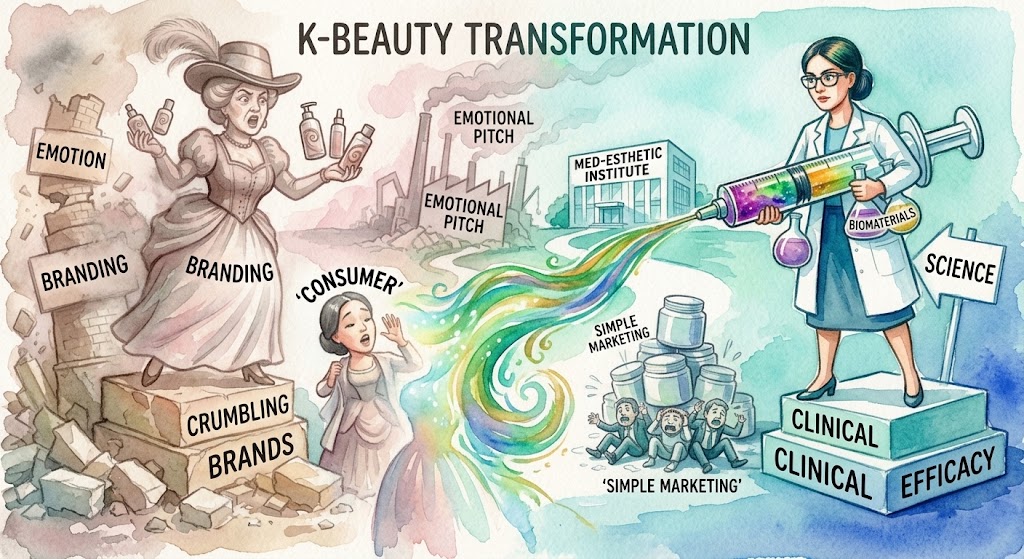
For years, the core competitiveness of K-Beauty relied heavily on attractive packaging, brand recognition, and emotional marketing. However, the industry is currently undergoing a fundamental transformation. Moving beyond general cosmetics and derma-cosmetics applied merely to the skin's surface, the K-Beauty landscape is being aggressively redrawn by Medical Aesthetics—specifically, clinic-use "Skin Boosters" that deliver active ingredients directly into the dermal layer to induce fundamental cellular regeneration.
1. The End of Emotional Marketing and the Rise of Medical Aesthetics
Skin boosters involve injecting nutrient-rich formulations directly into the dermis to structurally improve the skin. While conventional cosmetics are limited to surface-level moisturizing in the epidermal layer, skin boosters actively stimulate fibroblasts, which are responsible for generating the collagen and elastin lost due to aging.
Although the cost of medical aesthetic products and clinical procedures is significantly higher, consumers are increasingly willing to pay a premium for "definitive efficacy."
📊 Data Source According to the 2024 Foreign Patient Attraction Statistics published by the South Korean Ministry of Health and Welfare (MOHW), dermatology treatments accounted for an overwhelming 56.6% (approx. 705,000 individuals) of the 1.17 million foreign patients who visited South Korea. This clearly indicates that the central axis of K-Beauty has shifted to professional medical aesthetic procedures.
2. Emerging Leaders Dominating with Proprietary Technologies
The companies currently dominating the skin booster market share a common denominator: they have successfully established scientific validation of a single proprietary material alongside robust clinical procedural protocols.
- PharmaResearch (Rejuran): Pioneered the skin normalization market based on PDRN/PN, a cellular regeneration material extracted from salmon germ cells, growing into an enterprise targeting 500 billion KRW in annual revenue.
- VAIM (Juvelook): Resolved the drawbacks of existing collagen stimulators through biodegradable PDLLA microparticle technology, recording explosive sales growth and an operating profit margin exceeding 20%.
- L&C Bio (Re2O): Leveraging its human tissue graft technology, the company is opening a new market for fundamental skin structure reconstruction based on the Extracellular Matrix (ECM).
3. The Strategic Pivot of Beauty Giants
Stimulated by explosive growth, traditional cosmetic powerhouses (such as Amorepacific, LG H&H, APR, Cosmax, and Kolmar Korea) are undergoing structural reforms. They are realizing that simply expanding into derma-cosmetics is insufficient; their ultimate destination is the professional Medical Aesthetics sector.
| Comparison | Traditional Cosmetics | Medical Aesthetics (Skin Boosters) |
|---|---|---|
| Competitiveness | Brand recognition, emotional marketing | Proprietary technology, clinical data |
| Mechanism | Epidermal absorption, surface hydration | Direct dermal injection, cellular regeneration |
| Key Ingredients | Hyaluronic acid, plant extracts | PDRN/PN, PDLLA, Biomaterials |
Rather than stopping at consumer-grade beauty devices, these giants are aggressively securing medical-grade biomaterials and R&D capabilities to capture the high-margin clinic market. Ultimately, only companies that secure definitive proprietary material technologies and robust medical clinical protocols will seize supremacy in the next-generation medical aesthetic era.
Enjoyed this article?
Subscribe to CEO Daily Brief and get core insights into the South Korean market delivered to your inbox every morning.
Comments 0
No comments yet. Be the first to share your thoughts!