[Editorial] Unification, the Forgotten Zeitgeist and the 5,000-Year Territorial Destiny
[Editorial] Unification, the Forgotten Zeitgeist and the 5,000-Year Territorial Destiny
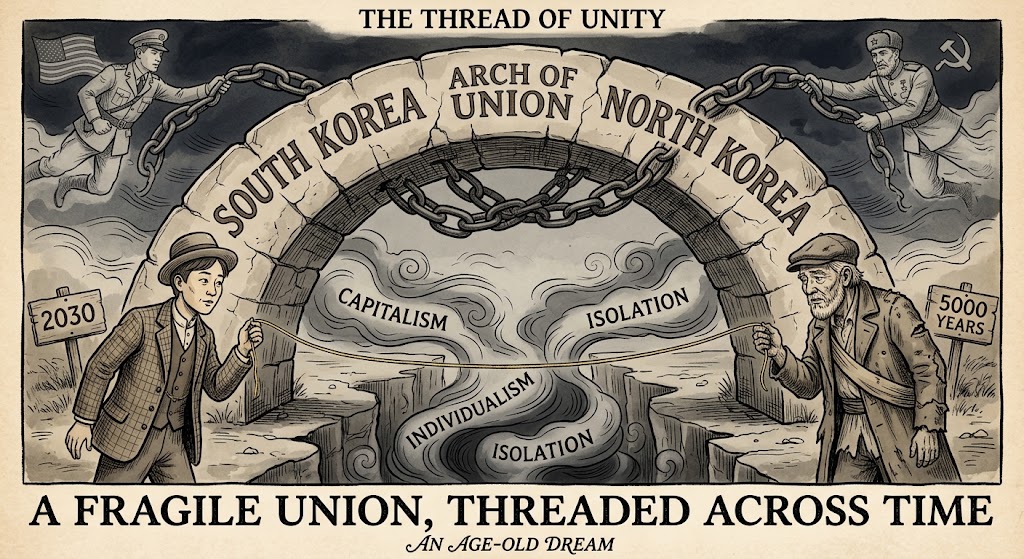
Merely seventy years ago, we were a homogenous nation, speaking the same language and tilling the same soil under a single national title. Though the nation was severed by the waves of international politics—the ideological conflict and the realignment of powers immediately following World War II—the absolute Zeitgeist deeply embedded in the hearts of both South and North was always ‘unification.’ While countless foreign invasions and tribulations exist throughout the 5,000-year history of the Korean people, never before had there been such a tragedy where compatriots sharing a single root were divided and pointed guns at each other for over half a century. ‘Our Wish’ was not just a simple song, but a proposition for national survival and a historical imperative.
However, as the 21st century set in, generations changed, and waves of globalization, extreme capitalism, and individualism swept over the Korean Peninsula. To today’s 2030 (the youth) generation, unification is no longer a heart-stirring national aspiration. Amidst excessive social costs, economic burdens, and the harshness of life, the grand discourse of unification is often dismissed as an anachronistic slogan or unrealistic idealism. South and North Korea, too, have laid down their sense of national solidarity and are racing toward a zero-sum structure of a cold ‘Squid Game,’ where one must defeat the other solely for the survival and continuity of their respective regimes.
While we consume the value of unification as a conceptual pastime or a scene in a strategic game, at this very moment, countless compatriots are moaning in blind spots. Have we ever felt genuine anger and pain even once regarding the suffering of North Korean defectors and overseas compatriots who cross the Yalu and Tumen Rivers, wandering through third countries and enduring lives no better than slavery in the blind spots of human rights? We live in an era where national pride and solidarity are vanishing, and all human and historical relationships are reduced to mere profit-and-loss statements and cold strategies of national interest.
Yet, we must not forget the great cause of history by becoming buried only in the calculator before our eyes. The desire of our ancestors who protected this land over the past thousand years was clear. It was to recover the historicity of our old lost territories, seized through division and encroachment, and to unite the national breath, encompassing Manchuria and the Korean Peninsula, to advance to the continent and the world.
Though times change and the language of generations may shift, the fundamental longing for national survival and prosperity can never be erased. We must rouse again the fading Zeitgeist of unification. Ending the tragedy of history and standing as one complete whole—that is the historical responsibility that we, living today, must answer before our ancestors and future generations.
Enjoyed this article?
Subscribe to CEO Daily Brief and get core insights into the South Korean market delivered to your inbox every morning.
Comments 0
No comments yet. Be the first to share your thoughts!