[Editorial] VT Pits 'Wild Ginseng' Against the 'Salmon King': Can Plant-Derived PDRN Overtake Rejuran?
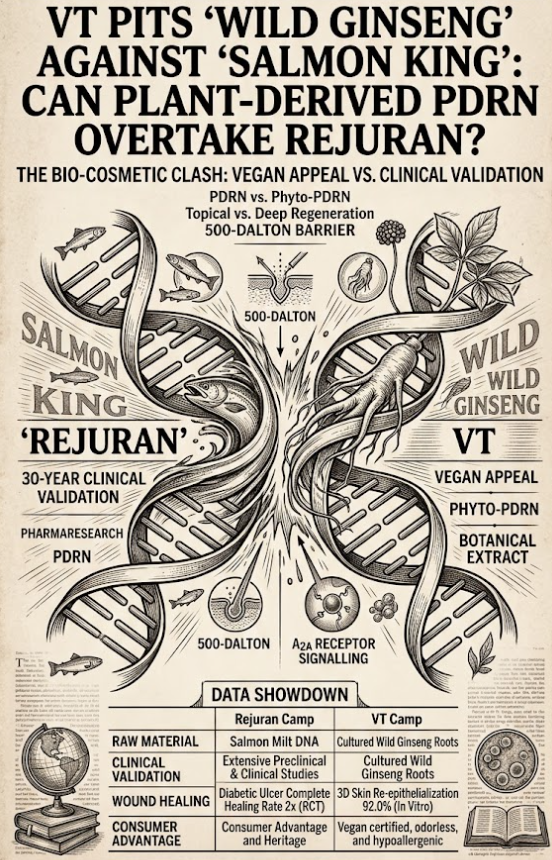
In aesthetic dermatology clinics worldwide, "salmon DNA therapy (Rejuran)" has long stood as an undisputed benchmark. PDRN (Polydeoxyribonucleotide), a specific DNA fragment mixture extracted from salmon milt, has dominated the regenerative aesthetic market for years thanks to its proven capacity to repair damaged tissue.
However, this fortress is facing a formidable challenger. VT Cosmetics launched an aggressive offensive across Olive Young and global e-commerce platforms with "Vegan PDRN" extracted from cultured wild ginseng roots. This has triggered a direct showdown between the original animal-derived camp—represented by PharmaResearch’s Rejuran Derma Healer—and the next-generation phyto-PDRN coalition led by VT.
Consumer sentiment remains sharply divided. One segment welcomes wild ginseng PDRN for eliminating fishy odors, potential seafood allergens, and animal welfare concerns. Another argues that a botanical extract cannot match the deep tissue regeneration proven by decades of clinical trials and medical injections. Beyond marketing claims, the physiological reality behind both compounds comes down to molecular biology and transdermal delivery engineering.
1. The 1-Million Dalton Paradox: Does Topical PDRN Actually Penetrate Skin?
Before assessing superiority, consumers face a fundamental scientific question: "How can massive macro-DNA fragments penetrate the stratum corneum and reach the dermis via topical application?"
Dermatology adheres strictly to the "500-Dalton Rule": only molecules smaller than 500 Da (0.5 kDa) can passively cross the skin's lipid barrier. Natural PDRN, however, is a polymer chain of nucleotides spanning 50 to 1,500 kDa (50,000 to 1,500,000 Da). In standard topical vehicles, it cannot penetrate the intact stratum corneum.
Nevertheless, topical PDRN formulations demonstrate measurable barrier recovery and anti-aging efficacy through extracellular signaling cascades and bypass metabolic pathways.
2. Salvage Pathway: Supplies pre-formed nucleotide fragments to stressed cells, enabling rapid DNA synthesis and turnover with minimal cellular energy.
3. Transdermal Delivery Formulations: Utilizes silica-based microneedles (spicules) and high-pressure microfluidization to bypass the stratum corneum physically and chemically.
PDRN does not necessarily need to saturate the deep dermis to initiate regeneration. By binding to A2A receptors on outer epidermal keratinocytes, it triggers intracellular secondary messengers (cAMP, PKA) to upregulate structural junction proteins. Simultaneously, micro-fragmented nucleotides act as ready-made "building blocks" via the salvage pathway. When coupled with micro-spicule systems (such as Reedle Shot) or nanoliposomes, transdermal bioavailability rises significantly.
2. Data Showdown: Salmon's "Clinical Moat" vs. Wild Ginseng's "Regenerative Power"
Animal and phyto-derived PDRN display distinct strengths and inherent limitations.
| Parameter | Rejuran Camp (Salmon PDRN) | VT Camp (Wild Ginseng Phyto-PDRN) |
|---|---|---|
| Raw Material | Salmon & trout milt DNA | Cultured wild ginseng root cells |
| Core Mechanism | Direct A2A receptor binding proven (DMPX antagonism) | A2A signaling + Phytochemical antioxidant synergy |
| Clinical Validation | Diabetic ulcer RCTs, 300,000+ patient prescriptions | 3D organotypic tissue models & small-scale pilot trials |
| Wound Healing | 2x complete closure rate in full-thickness wounds | 3D skin re-epithelialization of 92.0% (Outperforming EGF) |
| Consumer Advantage | Unmatched medical-grade heritage | 100% EVE VEGAN certified, odorless, hypoallergenic |
Animal-derived PDRN relies on an unassailable clinical moat. First commercialized by Italy's Mastelli in the 1990s for severe burns and chronic ulcers, its receptor-mediated pathway was definitively established when selective antagonists (DMPX) completely neutralized its regenerative effects in vivo.
Conversely, Phyto-PDRN demonstrates exceptional laboratory performance. In 3D human skin models (KeraSkin-FT), wild ginseng PDRN achieved a 92.0% re-epithelialization rate within five days, outperforming recombinant human EGF (47.9%). It adds native phytochemical antioxidant properties while securing an EVE VEGAN certification and eliminating animal allergy risks entirely.
3. Market Dynamics: Can VT Overtake Rejuran Cosmetics?
In market adoption, phyto-PDRN targets specific consumer pain points. For Gen Z and millennial consumers deterred by the extreme injection pain and high costs of clinical Rejuran procedures, the combination of "topical vegan PDRN + microneedle delivery" offers an accessible home-care alternative. Furthermore, its clean-beauty profile provides substantial tailwinds across Western and Asian retail markets.
However, phyto-PDRN must resolve two critical bottlenecks to permanently challenge the incumbent: expanding beyond in vitro data into large-scale, randomized human clinical trials (In vivo RCTs), and establishing standardized purification monographs to control batch-to-batch molecular weight variance across different botanical sources.
Yet, in the realm of deep tissue remodeling and pharmacological certainty, Rejuran's animal PDRN remains the established clinical standard. Phyto-PDRN's ability to claim the crown will depend not on marketing velocity, but on standardized extraction purity and rigorous human clinical evidence.
Enjoyed this article?
Subscribe to CEO Daily Brief and get core insights into the South Korean market delivered to your inbox every morning.
Comments 0
No comments yet. Be the first to share your thoughts!