The New Beauty Hegemony: How South Korea is Challenging France’s Global Empire
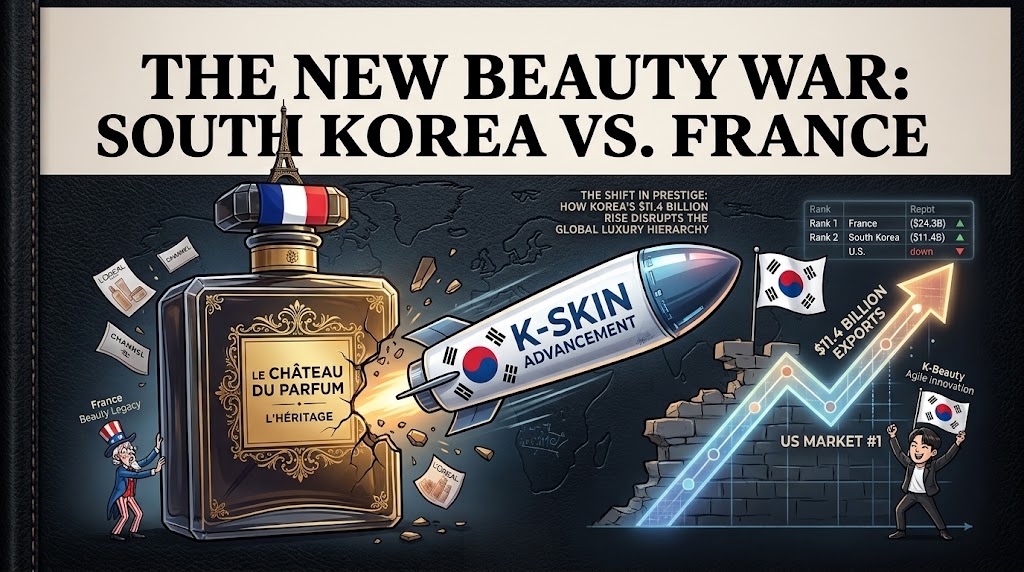
For decades, the global cosmetics industry operated under an undisputed sovereign: France. Powered by multi-generational heritage houses like L’Oréal, Chanel, and Dior, French beauty dictated global standards of luxury and efficacy. However, a seismic shift is underway. South Korea’s cosmetic industry has disrupted this traditional hierarchy, weaponizing agile supply chains and advanced dermatological innovations to challenge France’s historical monopoly on the global beauty landscape.
1. The $11.4 Billion Milestone: Ascending to Global No. 2
According to official trade data released by the Ministry of Food and Drug Safety of South Korea (MFDS), South Korea’s cosmetics exports reached an unprecedented $11.4 billion, marking an 11.8% year-on-year increase. This surge has allowed South Korea to surpass the United States, officially securing its position as the world's second-largest cosmetics exporter, trailing only France.
Crucially, this growth reflects a fundamental structural overhaul. Previously over-reliant on the Chinese market, South Korean beauty conglomerates and independent brands have successfully diversified their footprints, expanding active distribution networks to over 202 countries. The nation's cosmetics trade surplus simultaneously eclipsed the $10 billion threshold for the first time in history, establishing beauty as a primary driver of South Korea’s export economy.
| Rank | Country | Annual Export Value | Primary Market Driver |
|---|---|---|---|
| 1 | France | $24.3 Billion | Prestige Fragrance & Luxury Heritage |
| 2 | South Korea | $11.4 Billion | Advanced Skincare & Indie Brands |
| 3 | United States | $10.8 Billion | Mass Market & Clinical Beauty |
2. The Battle for America: Dethroning Legacy Luxury
The most alarming signal for French prestige is manifesting in the United States—the world’s largest and most competitive beauty consumer market. Data from the U.S. International Trade Commission (USITC) reveals that South Korea has overtaken France as the number one exporter of cosmetics to the U.S.
While French legacy brands have maintained their dominance in luxury department stores, their rigid brick-and-mortar reliance has left them vulnerable. In contrast, South Korean indie brands have masterfully captured younger demographics via digital-first ecosystems, dominating platforms like Amazon and TikTok Shop. By treating skincare as a holistic, preventive routine rather than a corrective luxury, South Korean brands have successfully shifted American consumer habits, redefining the market's baseline expectations for product formulation and speed-to-market.
3. Breaching the Gates of Paris
Perhaps the ultimate testament to South Korea's ascendancy is its rapid penetration into France's domestic territory. Long considered impervious to foreign beauty concepts due to intense national pride and strict regulatory barriers, European consumers are rapidly adopting Korean formulations.
The Korea Cosmetic Association (KCA) reported a staggering 71% year-on-year increase in exports directly to France, crossing the symbolic $130 million mark. This micro-trend is vividly illustrated by the retail landscape in Paris: premier institutions such as Galeries Lafayette have established dedicated, permanent spaces for South Korean skincare, integrating them alongside traditional European maisons.
Strategic Outlook: Bridging the Heritage Gap
While South Korea’s growth trajectory is mathematically aggressive, industry analysts note that France still maintains a substantial revenue lead ($24.3 billion vs $11.4 billion), insulated by its dominance in high-margin fine fragrances and elite luxury positioning. To completely neutralize the French advantage, the South Korean beauty ecosystem must execute three pivotal transformations:
- Premiumization: Elevating portfolio structures from highly accessible indie products to high-end clinical luxury.
- Category Expansion: Diversifying beyond functional skincare into premium color cosmetics and high-end perfumery.
- Strategic M&A: Leveraging substantial venture capital to acquire European heritage brands, effectively buying immediate access to historical brand equity.
The global beauty industry is no longer an exclusive European monoculture. Armed with unparalleled innovation velocity and structural agility, South Korea has evolved from a trendsetting challenger into a formidable empire, systematically dismantling the centuries-old boundaries of prestige beauty.
Enjoyed this article?
Subscribe to CEO Daily Brief and get core insights into the South Korean market delivered to your inbox every morning.
Comments 0
No comments yet. Be the first to share your thoughts!